

Preferences strategic vision
I lead a omni-channel roadmap discovery initiative focused on building the foundational layer that makes personalization possible at Macy's. By creating a unified approach to capturing, understanding, and activating customer preferences across channels, this work enables experiences to feel relevant, intentional, and customer-led.
Company & role
Macy's Inc.
Senior UX Designer
Timeline & platform
3 Months
Macy's Web, app, & in-store experience
The problem
Personalization existed but it didn’t feel personal
Customer problem
Recommendations, search results, and content often felt generic and overwhelming. Preferences like size, style, and brand affinity weren't reflected in meaningful ways, forcing customers to sift through massive assortments.
Business context
Fragmented preference capture and reliance on behavioral data limited our ability to deliver relevant, scalable personalization—causing lower engagement, higher bounce rates, and missed revenue opportunities.
The goal
Create a system customers could actually trust
Create a unified, omnichannel preferences ecosystem that allows customers to clearly express what matters to them, and ensures those preferences are consistently honored across every channel: app, web, email, & in-store.
My approach
Gain clarity, then design for scale
To begin, I synthesized cross-industry patterns in how preferences are introduced, reinforced, and activated, using those insights to align stakeholders on what “good” looks like from a customer perspective.
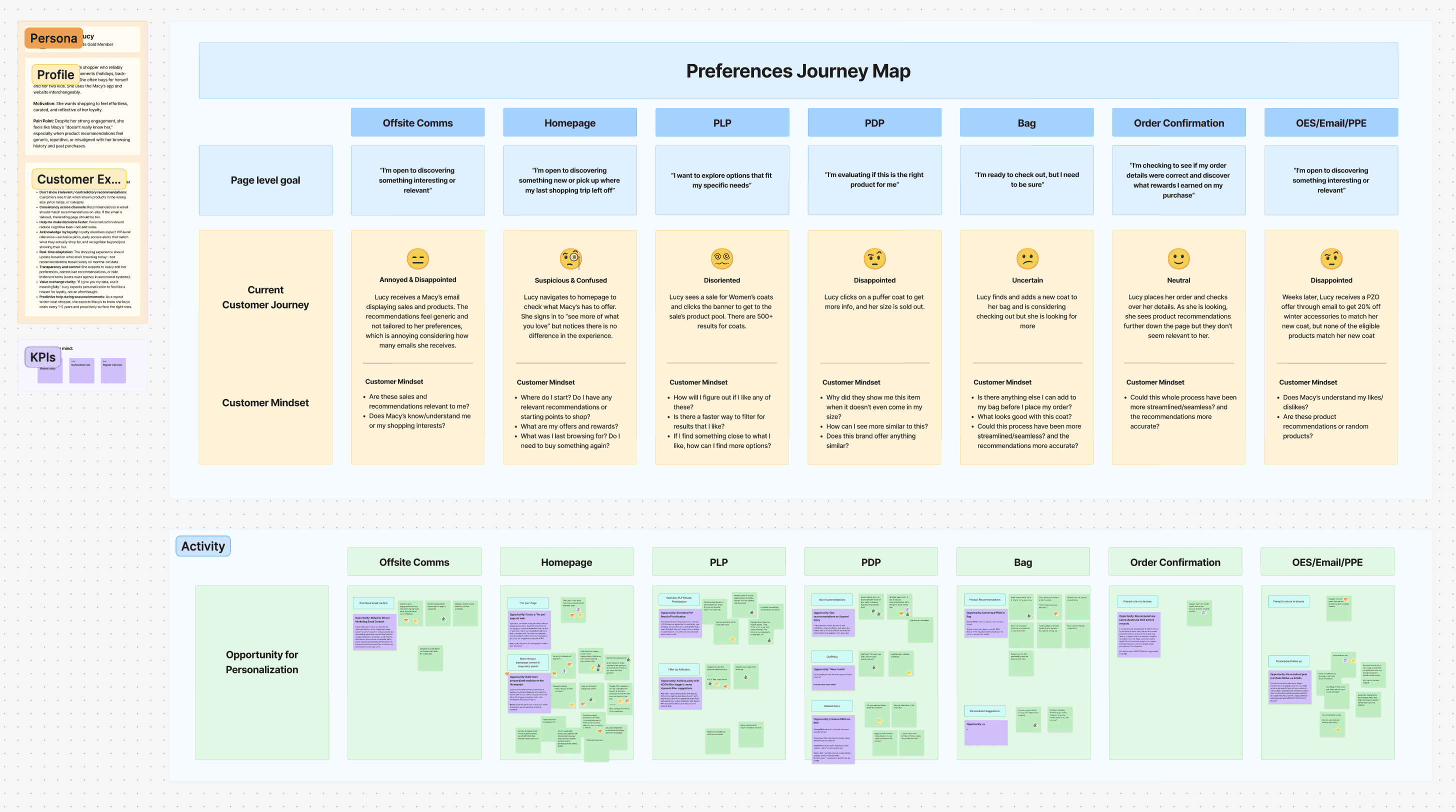
I then conducted a customer journey mapping workshop where we identified the highest-leverage moments where preferences could drive relevance at scale.
MVP scope
Building toward a system
I collaborated with the core team (Product, Engineering, Analytics, and UX Research) to define an MVP scope that we will begin to validate through rapid prototyping and usability testing. The initial scope centers on the Macy’s app, our most engaged and loyal channel, where the majority of customers are already signed in.
MVP Features to test:
Preference onboarding flow and a centralized preference editing center on the app For You page
Preference capture on PLP filters and order confirmation page
"My sizes" filter on PLP
"See more in my size" link on PDP when the user's size is out of stock
Strategic vision
A single framework to align personalization at scale
Next, I drafted a strategic decision tree to clarify how customer preferences flow from capture to activation. This framework is helping to align teams, surface dependencies, and ensure each experience works as part of a connected personalization system. We are continuing to size and prioritize this work for 2026. Key strategic pillars:
Design principles
Guiding scalable personalization
Last, I defined design principles to ensure every feature in the roadmap will consistently reinforce the personalization strategy, guiding decisions toward relevance, scalability, and long-term impact.
Relevancy
Search and recommendations reflect known preferences